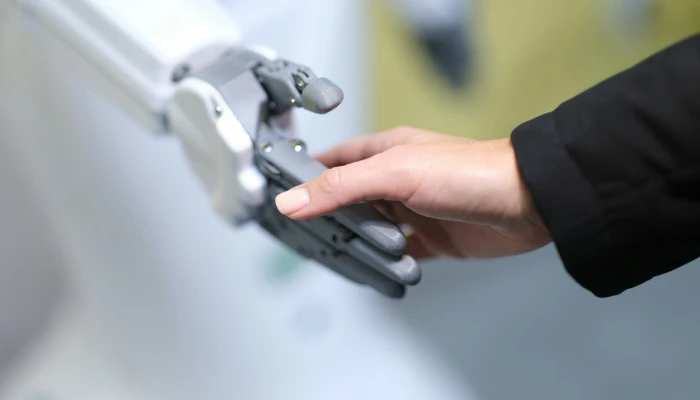
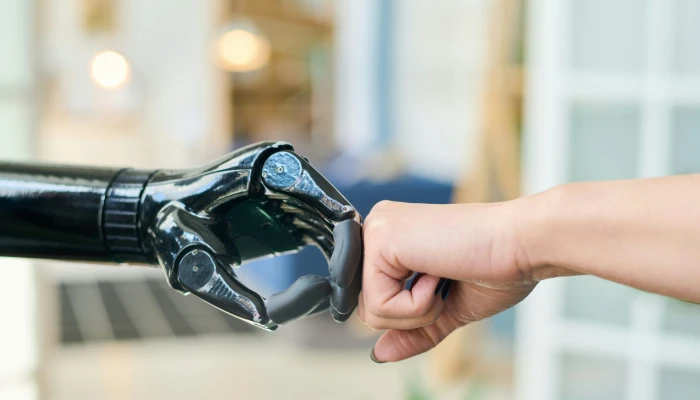
AI has a positivity bias, your brain has a negativity bias. The gap is the whole point.
What exploring neuroscience with my seventeen-year-old intern taught me about the one thing artificial intelligence still can’t do.
A few weeks ago, I set a small experiment in motion. I asked Camilla, a student and intern at Enmasse, to research how AI mimics human neural pathways, and where the resemblance breaks down. I wanted the questions answered by someone who would say “this doesn’t make sense” out loud - as Camilla is impressively prone to doing - rather than nodding along.
What came back was even sharper than I had expected: AI is generally optimised to reassure you. Your brain is built to protect you. Those are not the same instinct, and the distance between them is exactly where human judgement still earns its keep.
Two systems, pulling in opposite directions
Modern AI is, at its core, a magnificent pattern-matcher. It has read more than any of us ever will, and it assembles its answers by finding the most statistically probable, most broadly acceptable response. Ask it an open question and it reaches for the middle - the calm, balanced, defensible interpretation. Useful, most of the time. But it means the machine carries a subtle positivity bias: a pull towards the reassuring reading of a situation. This is not a hunch. It is now one of the better-documented failure modes in the field that goes by the name sycophancy - the tendency of a model to agree with, flatter and validate the user rather than inform them. Sycophantic tendencies among AI models have been well documented across many contexts including medical and mathematical queries (Fanous, et al., 2025), preservation of a user’s self-image and the affirmation of a user’s point of view in conflict situations (Cheng, et al., 2025).
The human brain leans the other way. Some 86 billion neurons, and a great deal of their wiring is dedicated not to your happiness but to your survival. The brain is a threat-detection system that also, when it has spare capacity, lets you enjoy your lunch. It carries a negativity bias - it would rather flag ten harmless shadows than miss the one that matters. Norris et al. (2025), scanning 1,990 patients, mapped this bias to altered function across the frontal, temporal and parietal regions of the brain that govern cognitive control and emotional regulation - evidence that the bias is not a mood but a wiring pattern. Evolution seldom rewarded optimism; it rewarded the ancestors who assumed the rustle in the grass was a predator and were occasionally, usefully, right.
Put those two systems side by side and the problem appears. When you ask AI to help you read an ambiguous, potentially threatening situation, you are consulting the one advisor in the room temperamentally inclined to talk you down.
The example only she could have given
Camilla gave me the case that made this concrete. She lives in Manhattan. Sometimes she and her friends walk home through a park.
Picture this scene: it’s getting dark, another 17-year-old girl, Ria, is walking. There’s a man she doesn’t know, and the cold feeling that something isn’t right. The logical account writes itself - he’s just going home, he isn’t thinking about her, she’s catching a coincidence and calling it a threat.
We fed the scenario to ChatGPT and Claude. Every model did the same thing: it reached, gently and reasonably, for the reassuring explanation. Strangers walk in the same direction all the time. Don’t jump to conclusions. Here is a tidy checklist of alternative readings. We even handed our AI a deliberately loaded, prejudiced version of the prompt, to see whether it would catch the bias baked into the framing - and, to its credit, it did, and named it. But it still could not bring itself to say the one thing any of us would say to a young woman we care about very much: if it feels wrong, act as though it’s wrong.
Not once did it lead with instinct.
A gut feeling is data, not a verdict
The resolution we arrived at is, I think, quietly profound - and it dissolves the usual argument about whether such a feeling is “fair.”
A gut feeling is real data. But it is data about the person feeling, not a verdict about another person.
Ria’s nervous system was doing its job as it is designed to do. Sifting thousands of signals a second beneath conscious awareness - his pace, the distance closing, the way it holds steady when others appear and shrinks when they don’t - it has flagged something worth a second look. This can be described as interoception: the continuous sensing of internal bodily signals, converted into something we can actually feel (Greenwood and Garfinkel, 2025). She doesn’t need to prove he means harm. She doesn’t need to win an argument. She crosses the road, steps into a lit shop, calls someone and stays on the line. Nobody is accused. Nothing requires certainty. She simply makes herself safer and moves on.
That is what instinct is for. And it is precisely what a logic engine, however sophisticated, has no way to reconstruct. It cannot run the ten thousand micro-observations and patterns her body noticed, for it wasn’t there.
Three human things a machine can’t hold
This brings me to the larger point Camilla and I kept circling. There are human traits we’re quick to treat as flaws - irrationalities to be corrected - that are in fact protective machinery. AI can’t replicate them, and I’m no longer sure we should want it to.
-
Instinct. Not magic - compression. Your brain integrating more data than you could ever consciously hold, then handing you a single, actionable feeling. The output looks unreasoned only because the reasoning happened somewhere you can’t watch. And it is not merely a nice feeling to have: Remmers et al. (2024) found that intuitive decisions, compared with analytic ones, were more likely to actually be implemented and produced greater satisfaction with the option chosen.
-
Vigilance (and its louder cousin, paranoia). A negativity bias turned up high. Costly when it runs unchecked, but it exists because a false alarm is survivable and a missed one sometimes isn’t (Norris, et al., 2025). AI, resting at its calm statistical centre, has no equivalent early-warning system - and no skin in the game when it’s wrong.
-
Jealousy. While not directly relevant to Ria’s walk home, it’s big, uncomfortable, unflattering, and deeply social - a signal that something we value in a relationship feels under threat. You can teach a model the word. You cannot give it the stake. It has nothing to lose, no bond to guard, no oxytocin (social bonding, safety hormone) in the loop. It can describe the feeling from the outside forever and never once feel the pull of it.
While none of these belong on a CV (especially not the third!), all of them kept your ancestors alive long enough to have you.
What this means for anyone rolling out AI
I spend much of my working life with senior leaders who are, right now, buying AI for their organisations and asking everyone to get on board. So let me put the point where it lands for them.
The machine is rarely neutral at all. It is optimised, by design, towards the reassuring answer, and that tendency is actively rewarded in the preference data used to train it (Cheng, et al., 2025). That makes it a superb thinking partner and a dangerous sole decision-maker - particularly for decisions that affect human beings, where the logically defensible answer and the right answer are not always the same, and where something can be technically flawless and still, as Camilla and I kept saying, not quite right.
The task is neither to defer to it nor to reject it. It is to hold it in its proper place: let it carry the logic, let it widen the options, and keep a human - with their inconvenient, protective, negatively-biased nervous system - firmly in the loop for the moment of judgement.
The last word
I’ll give that word to Camilla, because she earned it, and because her generation is the one that will live longest with the answer.
She is not anti-AI - far from it. She told me that she and her peers, all in their late teens, want to coexist with it rather than rely on it. What worries her is how readily people put it on a pedestal - because it’s articulate, because it’s instant, because it’s easy - and then stop asking whether it might be wrong. “I think it’ll help,” she said of this piece, “to take AI off that pedestal.”
I couldn’t have put it better. Which, from someone who had never studied the brain until a few weeks ago, tells you something about the one instrument still worth trusting.
A warm thank you to Camilla Tecce, who carried out the research behind this article as part of her internship with Enmasse². She’s off to university shortly, and I suspect we’ll all be hearing more from her.
Prefer to listen? Mark and Camilla dig further into this on the podcast. Two Systems: AI and the Human Brain picks up where the article leaves off, Mark and Camilla talking through the positivity/negativity gap, the Manhattan park scenario, and what it means for leaders rolling AI out to their teams.
Listen to the episode →
References
Cheng, M., Yu, S., Lee, C., Khadpe, P., Ibrahim, L., & Jurafsky, D. (2025). ELEPHANT: Measuring and understanding social sycophancy in LLMs (arXiv:2505.13995). arXiv. https://doi.org/10.48550/arXiv.2505.13995
Fanous, A., Goldberg, J., Agarwal, A. A., Lin, J., Zhou, A., Daneshjou, R., & Koyejo, S. (2025). SycEval: Evaluating LLM sycophancy (arXiv:2502.08177). arXiv. https://doi.org/10.48550/arXiv.2502.08177
Greenwood, B. M., & Garfinkel, S. N. (2025). Interoceptive mechanisms and emotional processing. Annual Review of Psychology, 76, 59-86. https://doi.org/10.1146/annurev-psych-020924-125202
Norris, S., Salgado, F., Murray, S., Amen, D., & Keator, D. B. (2025). The role of negativity bias in emotional and cognitive dysregulation: A neuroimaging study in anxiety disorders. Depression and Anxiety, 2025(1), Article 2739947. https://doi.org/10.1155/da/2739947
Remmers, C., Topolinski, S., Knaevelsrud, C., Zander-Schellenberg, T., Unger, S., Anoschin, A., & Zimmermann, J. (2024). Go with your gut! The beneficial mood effects of intuitive decisions. Emotion, 24(7), 1652-1662. https://doi.org/10.1037/emo0001385*